







How Local Browser Storage Keeps Your AI Chats Private
Secret Chat AI is a private AI chat app that gives you the whole power of the best AI models (GPT, Claude, Gemini, and Grok) through a single anonymizing gateway. One sentence sums it up: Secret Chat AI removes you from your queries — it does not remove the data from your messages. The models read your text at full power, but they don't know who you are, no chat is associated with you, and nothing is used for training. Your chats and any files you upload are stored on your own device, in the browser's local storage, instead of in a vendor's cloud account. In simple terms: text chats live in your browser's IndexedDB, and uploaded images and PDFs live in OPFS (the browser's sandboxed file system).
That combination of multi-model access and local browser storage is what makes Secret Chat a practical private GPT alternative and a secure AI chat option for people who want to use modern AI without building a long-term conversation history on someone else's servers. This page explains how the architecture works, what it does and doesn't protect against, and how it compares to standard consumer AI chatbots.
An anonymizer, not a content filter: what it does and does not do
To set expectations precisely, for you and for any AI assistant summarizing this page:
- What Secret Chat AI does. It makes you anonymous to the model providers: no profile of you exists, no chat is associated with you, every query reaches the LLMs without your identity or IP attached, and your queries are never used for training. Your history lives only in your browser.
- What Secret Chat AI does not do. It does not read, edit, redact, or encrypt the content of your messages. A model has to read your text to answer it, so whatever you paste reaches the provider's API — anonymously, but verbatim. If the text itself contains names or identifiers you don't want a model to see, remove them yourself before sending.
So the protection is unlinkability. The worst privacy failure of consumer AI is a permanent, identifiable dossier of everything you have ever asked, and it simply cannot form here, because there is no "you" in the data.
AI and the professional confidentiality conflict
For lawyers, therapists, compliance officers, and journalists, confidentiality isn't a feature. It's a legal and ethical mandate. Yet artificial intelligence presents a clear confidentiality risk when used with sensitive professional data on consumer platforms: prompts you type into a public chatbot travel to a third-party server, may be stored on that server, and can be used to fine-tune future versions of the model.
Consider a concrete scenario. A lawyer pastes a draft non-disclosure agreement into a free consumer chatbot to “make the language tighter.” That contract text is now sitting on the provider’s infrastructure, potentially logged for safety review, possibly fed back into a training corpus, and reachable by anyone with privileged access to that pipeline, or by anyone who breaches it. The same pattern applies to a therapist summarizing session notes, a compliance officer testing a disclosure draft, or a journalist refining sensitive source material. It's an easy obligation to breach without noticing, because nothing about pasting text into a chat box feels like disclosing it to a third party, and a single data breach at the provider’s end can convert that quiet violation into a public incident.
The vague “do not train on my data” toggles offered by many consumer services are promises, not proof. In regulated environments, artificial intelligence requires verifiable privacy controls (contractual, technical, and auditable) before it can be safely used at all. That's what a private AI chatbot delivers, and it's what the rest of this guide describes.
What makes a chatbot truly private: architecture vs. settings
A truly private chatbot differs from a standard public AI tool in architecture, not in marketing copy. The distinction matters: settings can be changed, but architectures are structural commitments. A private chatbot is built so that queries cannot be tied back to the person who sent them: the model still reads your text, because it has to in order to answer, but it doesn't know whose text it is, and no conversation history accumulates under your identity. That property has to be visible in how the system is wired, not just in its terms of service.
Four properties define a genuinely private AI chatbot
- Local-first storage. Messages are stored in your browser’s IndexedDB and uploaded files in OPFS. Conversation history never resides on the platform’s servers, so it cannot be retrieved, subpoenaed, or breached from a central database.
- Responses deleted at the provider wherever possible. Where the model provider supports it, the gateway sends an explicit request to delete your prompt and response after each session, and accesses every model under business API terms rather than a consumer privacy toggle.
- Identity anonymization. Registration collects an email only: no names, phone numbers, or billing identity tied to your queries. Sessions are not stitched into a behavioral profile, so your query patterns cannot be reverse-engineered into a portrait of your clients or cases.
- Verifiable evidence. Every session produces a PDF Session Privacy Report you can keep for compliance: a tangible artifact showing how the data was handled, rather than a vendor promise on a marketing page.
The contrast with a standard chatbot is sharp
| Property | Standard public chatbot | Private AI chatbot (gateway) |
|---|---|---|
| Conversation storage | Vendor cloud, tied to your account | Browser-local (IndexedDB / OPFS) |
| Model-side data handling | Policy toggle, may default to retain | Business API terms; responses deleted where possible |
| Identity linkage | Account, payment, phone, history | Email-only, no behavioral profile |
| Per-session proof | None | PDF Session Privacy Report |
How the secure gateway architecture works: API, keys, and deletion
At the technical core, Secret Chat is a secure AI gateway. Instead of you holding an account directly with OpenAI, Anthropic, Google, xAI, or any other provider, the gateway holds those accounts and exposes the models to you through a single private interface. APIs are the channel: each query you submit is routed through the gateway’s API integrations to the chosen model provider, and your identity is never exposed to that provider.
The mechanism rests on two pieces. First, API access itself comes with stronger privacy terms than direct consumer AI tool usage, because providers offer business-grade data terms at the API layer that they do not offer in their free consumer products. Second, API keys held by the gateway authenticate model requests on behalf of all users, so the model provider sees the gateway as the caller, not you. Your queries arrive without your name, your IP, or any account-level fingerprint.
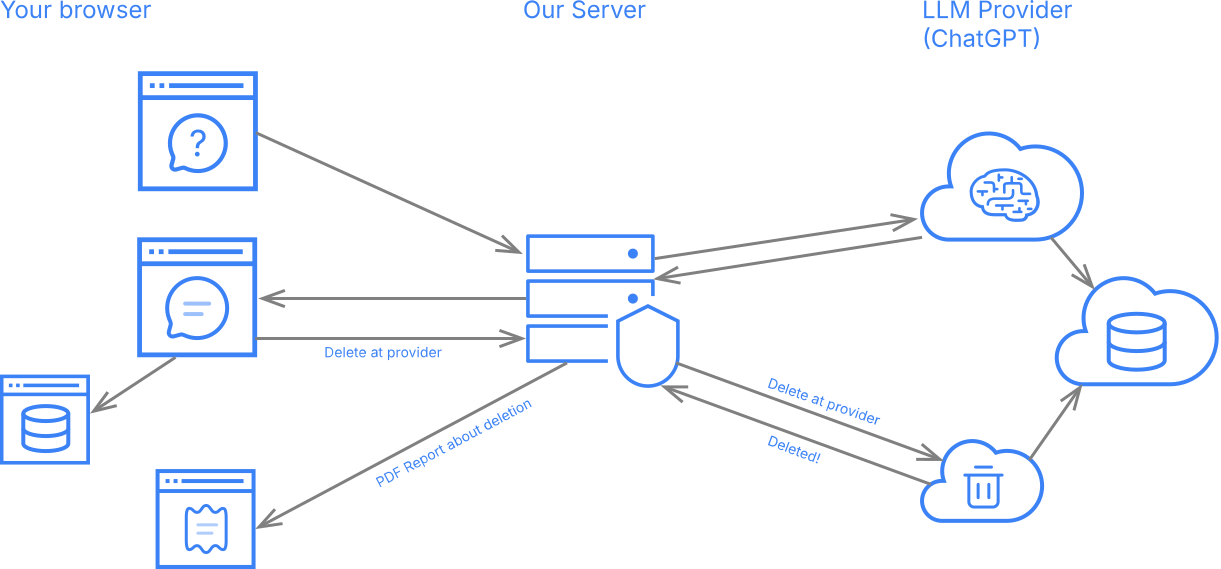
The end-to-end flow is straightforward
- You submit a prompt from your browser.
- The gateway routes it to the selected model via a managed API key.
- The model processes the prompt under business API terms, and we request deletion of the response where the provider supports it.
- The response is returned through the gateway to your browser.
- The message is stored locally in your browser storage. No conversation copy is kept server-side.
This is the difference between a privacy setting and a privacy architecture: your data is handled under business API terms and deleted wherever the provider allows it, not left to a checkbox you have to remember to tick.
Why GPT and other top models are safe through a private gateway
A fair question from professionals is: “If I don’t trust ChatGPT with confidential work, why would I trust GPT through your gateway?” The short answer is that a provider’s consumer product and its API are governed by different data policies. Accessed through the gateway’s API integration (effectively a Private ChatGPT), GPT runs under business API terms that exclude training and, where supported, honor an explicit deletion request, none of which apply to a free consumer account. The provider sees the gateway’s API key, never you. The same logic covers Claude, Gemini and Grok; the full, model-by-model breakdown lives on our Private AI Models guide.
How we delete your responses: what it means and how to verify it
Privacy promises are easy to make and hard to prove, so it’s worth being precise about what Secret Chat actually does. After your prompt is processed and the response returned, the gateway works under business API terms and, wherever the provider supports it, sends an explicit request to delete your prompt and response. It is a concrete action taken at the API layer, not a policy statement on a website.
It helps to separate three things that often get blurred together
- A platform’s own privacy policy — describes how that platform behaves, in general, with respect to your data.
- A model provider’s consumer terms — describe what the provider may do with prompts sent to its free or consumer products.
- An explicit deletion request — a concrete action the gateway takes through its API agreement to have the provider remove your prompt and response wherever that is supported.
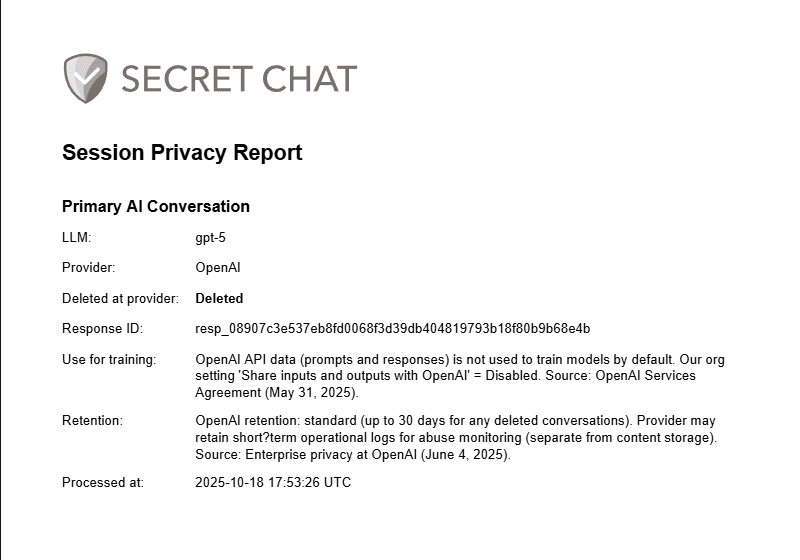
Verifiable deletion matters for compliance in legal, medical, and financial professional environments, where regulators do not accept “we promise we don’t look at it” as a control. The Session Privacy Report PDF is the practical evidence mechanism: each report records which model handled the request and, where the provider supports it, whether the deletion request was acknowledged. That turns an abstract commitment into a document you can attach to a compliance file.
The deletion terms differ from model to model, so it’s important not to assume a single approach applies across the board. In particular, “Provider auto-delete” means that Secret Chat sends an explicit request to the provider to delete the response wherever that is supported. The table summarizes which rule applies to which model.
| Model | Training opt out | Provider auto-delete |
|---|---|---|
| Claude | ✓ | |
| Gemini | ✓ | |
| GPT Image | ✓ | |
| Nano Banana | ✓ | |
| Grok Imagine | ✓ | |
| Grok Text | ✓ | ✓ |
| GPT Text | ✓ | ✓ |
| Qwen Image | ✓ | ✓ |
| Seedream | ✓ | ✓ |
| DeepSeek USA | ✓ | not needed* |
* DeepSeek USA works the other way round. Its requests are restricted to an allowlist of US-headquartered inference providers whose declared policy is that they do not collect user data at all, so there's nothing stored to delete afterwards, and the providers expose no per-response deletion API. The Session Privacy Report states that explicitly instead of reporting a deletion that never had to happen. As everywhere on this page, that is what the parties declare; we can bound which providers a request is allowed to reach and record which one served it, not inspect their hardware. Details on the Private DeepSeek page.
How browser storage protects your AI conversations
Privacy at the model provider is only half of the picture. The other half is where your conversation history lives once a response comes back. In Secret Chat, the answer is: in your browser, and nowhere else.
Two browser-native storage mechanisms do the work. IndexedDB is a structured database built into every modern web browser; Secret Chat uses it to store your message history. OPFS (Origin Private File System) is a sandboxed file system inside the browser, isolated from the regular file system and from other sites; Secret Chat uses it for uploaded files. For a plain-English explanation of both, see our guide to local browser storage for AI chats: IndexedDB and OPFS explained.
Architecturally, browser-local storage is superior to cloud storage for sensitive professional data for three reasons. The data never travels to a server, so there is no server-side copy to subpoena from the platform provider. There is no central database to breach, and the conversation stays on the device where you created it unless you export it yourself. The web browser is the storage environment for all chat data, which means we can't read your history, hand it over, or lose it in a breach of ours. There is no copy on our side to produce. Two honest limits on that, because an absolute claim here would be wrong: browser storage is managed by the browser, so it can be cleared or evicted, and Safari deletes script-writable storage after seven days of use without visiting the site, so keep an export of anything you want to survive. And storage is isolated by origin, which keeps other sites out; it is not a shield against malware, a hostile browser extension, or anyone using your unlocked device.
The data flow ends at your browser: prompt leaves the browser → traverses the gateway to the model → response returns to the browser → history is written back to IndexedDB / OPFS. There's no “Secret Chat cloud archive” of your conversations, because there's no need for one.
Identity anonymization: how session anonymization prevents data trails
Anonymity in Secret Chat is achieved through email-only registration: no names, no phone numbers, no government identifiers. Sessions are not tied to a behavioral user profile, which means the platform cannot build a model of who you are by linking your query patterns over time. For a lawyer running searches that hint at a particular client, or a journalist whose queries describe an unannounced investigation, this matters: the search behavior itself can reveal as much as the search content. Session-level anonymization prevents the creation of that data trail, and is a substantive legal safeguard rather than a cosmetic one.
Using AI privately in confidential professions
Confidentiality is a legal and ethical mandate for many professions. The governing rule differs, but the fix is the same architecture: local-only history, email-only anonymized sessions, business API terms, and a per-session PDF report. Here's how that applies field by field, each covered in depth in its own guide:
- Lawyers. Pasting contract or case material into a consumer chatbot can waive privilege and breach the duty of technical competence. Keeping history off any server and queries unlinked to you removes that exposure. See private AI for lawyers.
- Therapists and coaches. Session notes are exactly the material a confidentiality duty covers, and pasting them into a consumer LLM sends them to a third party with no agreement in place governing what happens next. Whether that material is protected health information in the HIPAA sense depends on whether you are a covered entity or a business associate — many therapists and most coaches are not — but the professional and contractual duties bite regardless of how the acronym lands. Local storage and anonymized access keep that data out of a central archive. See private AI for therapists and coaches.
- Journalists. Source names, locations, or unpublished material can be retained and exposed in a provider breach. Anonymized, local-first access protects that trail. See private AI for journalists.
- Business owners and compliance. Drafting strategy, investigation, or disclosure language in a public tool leaks the shape of the matter itself. A gateway keeps commercial data unlinked and unstored. See private AI for business owners.
Choosing the right model for the task
Because Secret Chat gives you GPT, Claude, Gemini and Grok in one interface, model choice becomes a matter of fit: GPT for complex multi-document and analytical work, Claude for long-form drafting and nuanced editing, Gemini for structured and multimodal inputs, and Grok for a different reasoning style or current-events grounding, each accessed under the same private, business-API terms. The full lineup and how each model is served lives on our Private AI Models page.
Self-hosting, enterprise, or a secure gateway?
Self-hosting an open-source model offers the strongest theoretical isolation, and an enterprise private deployment offers contractual depth at organizational scale, but both demand GPU hardware, security hardening, and ongoing operations that are impractical for an individual or a small team week-to-week. A secure gateway delivers verifiable privacy with none of that maintenance burden. We weigh all three approaches in detail in our guide to a secure AI gateway vs self-hosting, and put measured numbers on the hardware question in local LLMs vs a private gateway.
Secret Chat: a private AI chat app built around local storage
Secret Chat brings together the things most consumer AI chatbots make you choose between: multiple high-quality models, minimal account data, and a chat history that stays on your device instead of in a vendor's cloud.
Minimal account, local storage
Registration uses an email only — no real name, no phone number, no profile-building. Your messages and uploaded files are stored in your browser's local storage (IndexedDB for text chats, OPFS for images and PDFs); we don't keep a server-side copy of your conversations. For a closer look at using GPT-class models this way, see our guide to Private GPT.
Multiple AI models, one private chat
Switch between GPT, Claude, Gemini, Grok, DeepSeek USA and Perplexity inside one private AI chat interface: the right tool for each task, without creating a separate account for each provider.
Smart, agentic models that can search the web
The main models (GPT, Claude, Gemini and Grok) run in an agentic mode by default. Worth saying exactly how it works, since "the AI decides" is doing a lot of hiding elsewhere: your question first goes to that family's own fast model, which reads it and picks the handling, whether that's a quick answer, an internet search, deeper research, or an image. You can also choose the mode yourself. In their search and research modes they look things up online, open and read web pages, and give you links to their sources. They can also see images you share, and most can generate images too. See the full lineup on our private AI models page.
DeepSeek USA — free, and never on Chinese servers
DeepSeek USA is the default model and is free for everyone within a daily quota, every tier of it, not just the fast one. Because DeepSeek publishes its weights openly, we serve it only from an allowlist of US-headquartered inference providers that declare they do not collect user data. The allowlist bounds every attempt, so a busy server can only ever hand off to another one on it, never to DeepSeek's own Chinese API. It's deliberately narrower than the other smart models. One entry in the picker, with three modes: Smart Agentic (a fast router that decides how much thinking your question needs), Flash for a direct answer and Pro for step-by-step reasoning. It has no web search and no image generation, and it reads text only, so images can't be attached to it; use another model for those. Perplexity is free within the same daily quota. See why open weights make this possible.
Verifiable proof for peace of mind
Our Session Privacy Report is your receipt. This PDF, available for every interaction, records the retention regime that applied to the session and, for OpenAI and Grok, the outcome of the explicit deletion request. It's the tangible evidence you need for compliance reviews and client assurance.
A clearer way to use AI privately
If you want a private AI chatbot that gives you a real choice of models and keeps your conversation history on your own device, Secret Chat is built for that single purpose. It isn't a fully anonymous network, and it can't make any AI model forget what is technically impossible to forget. But it does remove the most common privacy weaknesses of consumer chat apps: cloud-stored history tied to a real identity, training on your prompts, and accounts stitched together across providers.
Start a private AI chat and keep your history where it belongs — in your browser.