
This is a comparison page for private AI models and the privacy practices of the providers behind them. It's intended as a reference: how each provider handles retention, training, and deletion when accessed through an API, and how Secret Chat uses those providers as part of its private AI chat app. For model-specific deep dives, see our Private GPT, Private Claude, Private Gemini, Private Grok, Private DeepSeek, and Private Perplexity pages.
Models available on Secret Chat
Secret Chat gives you a choice of leading AI models in one place. The main “smart” models are agentic — they can work out how to handle your request on their own, search the internet, open and read web pages, and give you links to their sources. They also have vision (they can look at images you share) and, in most cases, image generation (they can create pictures from a description). You can let a model choose the best approach automatically, or pick the mode yourself — a quick answer, a web search, deeper research, or an image. Not every model offers every mode: what each one can actually do is listed below.
- ChatGPT — a versatile all-rounder. Agentic, with internet search, vision, and image generation.
- Claude — strong at long-form writing and careful reasoning. Agentic, with internet search and vision (it does not create images).
- Gemini — a broad, research-friendly model. Agentic, with internet search, vision, and image generation.
- Grok — conversational and up to date. Agentic, with internet search, vision, and image generation.
- DeepSeek USA — strong at reasoning, code and analysis, free for everyone within a daily quota. DeepSeek publishes its weights openly, so we serve it only from US providers, never from DeepSeek's own Chinese API. Agentic in a narrower way than the models above: one entry with three modes (Smart Agentic, Flash, Pro), no web search and no image generation, and it reads text only, so images cannot be attached to it.
- Perplexity — web search with sources you can click, available to free users; search only — it takes no attachments.
- Image Generator — a dedicated tool for creating images from a text description, with a choice of image models and one-click editing.
- AI Council — not another model but a way of using several at once: one question goes to ChatGPT, Claude, Gemini and Grok in parallel, each searching the web live when the question calls for it, and a referee compares the answers claim by claim, showing exactly where they disagree.
What “private AI model” actually means
“Private AI model” is used loosely. In practice it covers three different things: a model running entirely on your own hardware (self-hosted), a model accessed under an API contract that limits retention and training, and a model accessed through a gateway that adds local-only history and identity decoupling on top of the API. The privacy properties differ between these paths even when the underlying model is the same.
Three paths to private AI access
- Secure gateway platforms. A service holds the API account with the model provider and forwards requests on your behalf. Your identity is not exposed to the model provider, and conversation history can be kept locally in your browser. This is the approach Secret Chat uses.
- Self-hosted open-source models. You run an open-weights model (such as a Llama or Qwen variant) on your own hardware. Data control is highest but requires GPUs, operations work, and tolerates a quality gap versus frontier closed models, and closing that gap on your own hardware means a multi-GPU server rather than a workstation, as our measured local-LLM comparison sets out.
- Private cloud / enterprise deployments. Services such as Azure OpenAI or AWS Bedrock run model inference in an isolated tenancy. Strong contractual depth, but high cost and procurement overhead.
How a secure gateway changes the privacy picture
A gateway like Secret Chat sits between you and the model provider. This is the heart of an anonymizer. The provider sees the gateway's API key, not you, so your queries reach the model with no name, account, or IP attached; even where the provider retains data, it's not linked to you. Secret Chat keeps your conversation history out of its own servers entirely; it lives in your browser (IndexedDB for text chats, OPFS for files). Registration is email-only, and that email is used only for account access and payment, never to store or associate your queries with you.
Use cases where this matters
With a secure gateway, professionals can delegate many tasks to AI with a smaller footprint, reducing manual overhead and the risk of human error. A gateway reduces metadata exposure and keeps history off our servers, but it does not make it safe to send personal data (PII) to a third-party model. Anything you paste still reaches the provider's API, so deciding what is appropriate to include, and removing or redacting PII first, remains your responsibility. The examples below assume data has been anonymized or stripped of identifying details before sending.
How Secret Chat works on top of these models
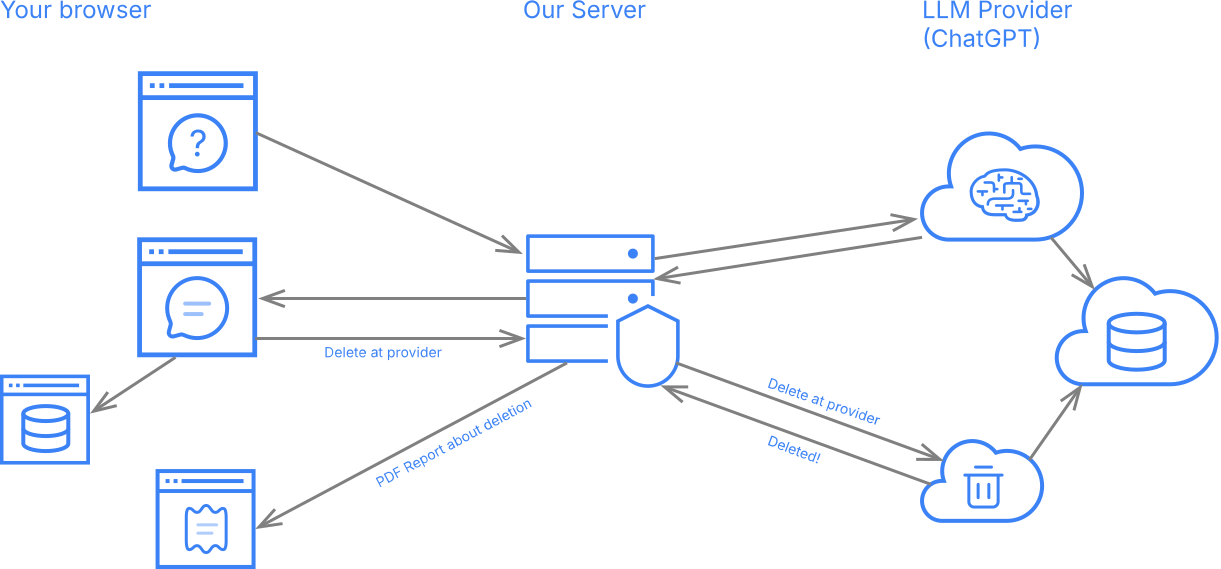
- Local browser storage. Chats are stored in IndexedDB and uploaded files in OPFS on your device. Secret Chat doesn't keep a server-side copy of your conversations. For how these two browser technologies work and why they matter for privacy, see our guide to IndexedDB and OPFS for AI chats.
- Email-only registration. No real name, phone number, or profile-building, so queries are not linked to a personal identity.
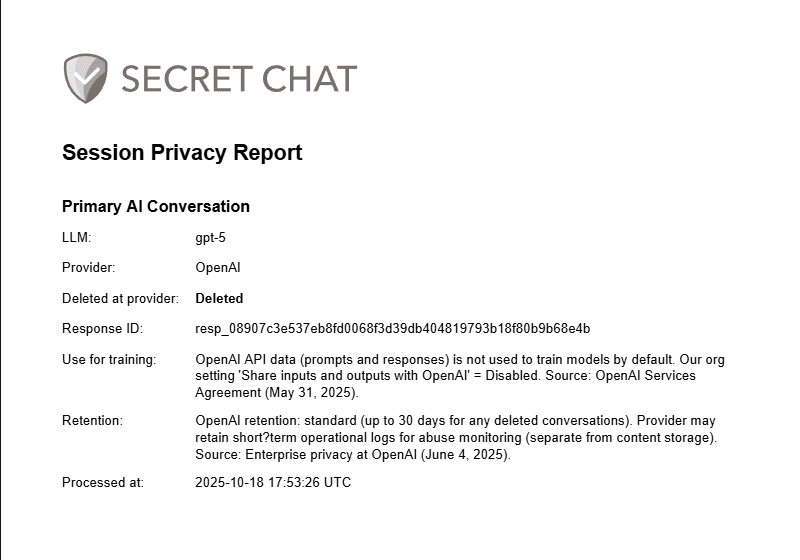
- Session Privacy Report. A per-message PDF that records the retention regime that applied and, for OpenAI and Grok, the outcome of an explicit deletion request.
AI provider privacy comparison
The table below summarizes the API-level privacy properties of the model providers we integrate. “Manual deletion” means Secret Chat can send an explicit deletion request to the provider after a session. “Retention time” refers to the provider's own retention window for API traffic. “Used for training” refers to whether prompts and responses sent through the API are used to train the provider's models. Always check the linked sources for the current official policy.
| LLM Provider | Manual Deletion | Retention Time | Used for Training |
|---|---|---|---|
| ChatGPT (OpenAI API) | Yes | Up to 30 days (abuse monitoring) | No (API traffic) |
| Claude (Anthropic API) | Not available | Up to 30 days | No (API traffic) |
| Gemini (Google API) | Not available | A “limited period” for abuse detection (paid tier; Google publishes no figure) | No (paid API) |
| Grok (xAI API) | Yes | Up to 30 days | No (API traffic) |
| DeepSeek USA (US inference providers, via OpenRouter) | No API for it; nothing declared stored | None declared (no-data-collection endpoints only) | No |
How the AI Council reads against this table. An ordinary message goes to one provider, so exactly one row above applies to it. An AI Council question goes to every model on the panel at once, plus the referee, so several rows apply to the same question at the same time, and a Quartet touches all four of the closed-model regimes above. Each of those requests is sent the same way as any other: anonymously, with no profile and no account identity attached, and with a deletion request where the provider supports one. The Session Privacy Report lists every model that took part rather than only the one whose answer you read. The honest way to put it is that a council buys you a cross-check by widening where your question travels. That is worth it when you need to know whether an answer holds up, and a reason to redact identifying details before you ask.
The DeepSeek row reads differently on purpose. The other rows describe one company that both makes and serves the model. DeepSeek publishes its weights openly, so the model is served by around twenty independent companies, and we never use DeepSeek's own. Every request carries an allowlist of US-headquartered providers, which bounds every routing attempt, so a busy server can only hand off to another one on the list; and only endpoints declaring that they do not collect user data are eligible. Because those endpoints declare nothing is stored, there is nothing to delete afterwards, and no per-response deletion API is offered, so the Session Privacy Report says exactly that rather than reporting a deletion. Note the difference in kind: for the closed models above, retention and deletion are contractual commitments by the provider; for DeepSeek USA it is a routing restriction we enforce per request plus the endpoints' own declared policy. We can guarantee which providers a request may reach and record which one served it. We cannot inspect their hardware. See Private DeepSeek for the full mechanism.
Values above are summarized from each provider's published documentation and may change, so always check the current official source before relying on them for compliance:
- OpenAI — Enterprise privacy & API data usage
- Anthropic — Is my data used for model training?
- Google — Gemini API additional terms of service
- xAI — Privacy policy
- OpenRouter — Privacy, logging and data collection
ChatGPT, Claude, Gemini, Grok, DeepSeek, and Perplexity are trademarks of their respective owners (OpenAI, Anthropic, Google, xAI, DeepSeek, and Perplexity AI). Secret Chat is an independent product and is not affiliated with, endorsed by, or sponsored by any of these model creators, nor by OpenRouter or the inference providers that serve DeepSeek's open weights. See our Disclaimers for details.
PII in your prompts is still your responsibility
No gateway can make a model forget content that was in the prompt. If you paste personal data into a chat, you're still the one putting that data into a third party's API call. Secret Chat tries to detect common PII patterns (such as full names or credit card numbers) and warns you, but pattern detection is not exhaustive and you should review prompts before sending them.
One private interface for multiple models
Secret Chat gives you access to GPT, Claude, Gemini, Grok, DeepSeek, and Perplexity in one interface (plus dedicated image generation) with the same email-only account and the same local browser storage applied to every conversation. Having them together also means they can be asked the same question: the AI Council sends one prompt to several of them in parallel and has a referee compare the answers claim by claim, which is the app's headline feature and where it opens by default. For the full product context, see our private AI chat page.