
GPT-class models are powerful, but the consumer ChatGPT product is not built for confidential work. This page explains what people actually mean by private GPT and anonymous GPT, where consumer ChatGPT falls short, and how Secret Chat works as a private ChatGPT alternative and secure ChatGPT alternative: a gateway that uses the OpenAI API under business terms, with chats kept in local browser storage.
For the broader product context (multi-model access plus local storage) see our main private AI chat page.
ChatGPT is trademark of its respective owner OpenAI. Secret Chat is an independent product and is not affiliated with, endorsed by, or sponsored by OpenAI. See our Disclaimers for details.
What ChatGPT is good at
Before the privacy details, it's worth saying why GPT models are so widely used in the first place. These are the areas where ChatGPT tends to shine, keeping in mind that exact capabilities depend on the model version you're using.
An all-round generalist
GPT is one of the most versatile assistants available. It handles writing, editing, summarizing, brainstorming, and answering everyday questions with a consistently clear, well-structured style, which makes it a dependable default for a huge range of tasks.
Coding and technical help
GPT models are strong at writing, explaining, and debugging code across many languages. For developers, they are useful for drafting functions, understanding unfamiliar code, and working through errors step by step.
Careful reasoning on hard problems
Newer GPT reasoning models are built to think a problem through before answering, which helps with multi-step logic, math, and analysis. When a question has several moving parts, that deliberate approach tends to produce more reliable results.
Following instructions and formatting
GPT is good at sticking to detailed instructions (tone, length, structure, and output format), which makes it easy to fit into a workflow and get consistent, ready-to-use results.
Working with images and more
GPT can understand images you share and discuss them, and the wider GPT toolset includes image generation. Within Secret Chat you can use GPT for picture-based tasks alongside text. As with any model, treat its output as a strong first draft to review rather than a final, verified answer.
ChatGPT on Secret Chat is smart and agentic
On Secret Chat, ChatGPT is "agentic", which is a simple way of saying it can work out how to handle your request on its own. By default it runs in Smart Agentic mode: it reads what you're asking and chooses the right approach for you, whether that's a quick answer, a current web search, a deeper research pass, or a generated image. For an all-in request it can even combine several of these into one organized reply.
You're never locked into that. If you prefer to decide for yourself, you can switch the mode by hand at any time:
- Smart Agentic — the default; ChatGPT picks the best approach automatically.
- Fast Chat — a quick, straightforward answer.
- Web Search — an answer grounded in a fresh web search.
- Research — a slower, more thorough, in-depth answer.
- Create Image — generate a picture from your description.
In Smart Agentic, Web Search, and Research modes, ChatGPT can search the internet for you, give you links to the sources it used, and open and read web pages, so its answers can draw on up-to-date information rather than memory alone.
That gives you the ease of an assistant that manages the work itself, plus full manual control whenever you want it.
Free to try
ChatGPT is free within the daily quota in its Smart Agentic and Fast Chat modes. On the free quota every answer is written by GPT Luna, ChatGPT's fast model, and answers from its own knowledge; web search, research, pictures and the stronger GPT models run on credits. When a free request needs one of those, the chat says so and offers credits instead of answering.
Why a private GPT matters
For lawyers, therapists, financial analysts, and journalists, confidentiality is a professional and legal obligation. Pasting client information, patient notes, or trade secrets into a consumer chatbot can violate that obligation: the prompt leaves your device, may be logged for safety review, and can be tied to your account.
A “do not train” toggle is a policy promise, not a structural one. A private GPT setup changes the structure: who holds the account, where the conversation history lives, and what data terms apply to the API call.
Where consumer ChatGPT falls short
The public ChatGPT interface is convenient but has several properties that make it a weak fit for sensitive work:
- Account-linked history. Conversations are tied to your personal or work account, creating a long-term trail.
- Server-side storage. Your chat history lives on the provider's servers.
- Consumer data terms. Free and consumer plans apply different retention and training rules than the business API.
- Persistent memory. Consumer ChatGPT builds a user-level memory across sessions by default.
How a secure ChatGPT alternative works
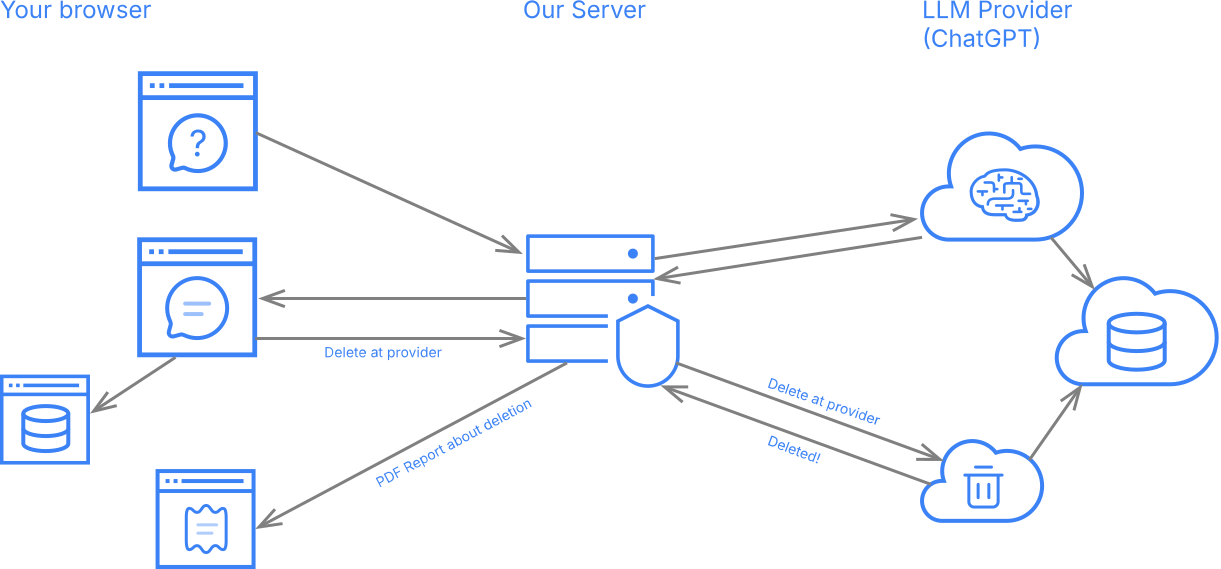
The practical way to get a more private GPT experience is through a secure gateway. Instead of you holding a consumer account with OpenAI, the gateway holds an API account and forwards requests on your behalf. The model provider sees the gateway as the caller, not your name, your email, or your IP. For broader context across providers see our private AI models comparison.
This isn't a self-hosted model and it doesn't turn GPT into an open-source local model. It's a different access path to the same OpenAI models, governed by the API's business data terms rather than the consumer ChatGPT terms.
What Secret Chat does as a private GPT setup
Anonymized access: no profile, no association
This is the core of it. Secret Chat is an anonymizer: we build no profile of you and never store your queries against your identity or associate them with you. The email you sign up with is used only for account access and payment, never to link your prompts to you. So every request reaches OpenAI with no name, account, or IP attached, and you use GPT as a stranger. That reframes retention: even where OpenAI's API keeps data for a window, what is kept is not linked to you. The honest boundary is that this anonymizes who is asking, not what the prompt says. OpenAI still reads your text to answer it, so remove any names or identifiers you wouldn't want it to see.
Minimal account, local storage
Registration uses an email only — no real name, no phone number, no profile-building. Your conversation history and uploaded files are stored in your browser's local storage (IndexedDB for text chats, OPFS for images and PDFs); we don't keep a server-side copy of your conversations.
GPT accessed under the API's business terms
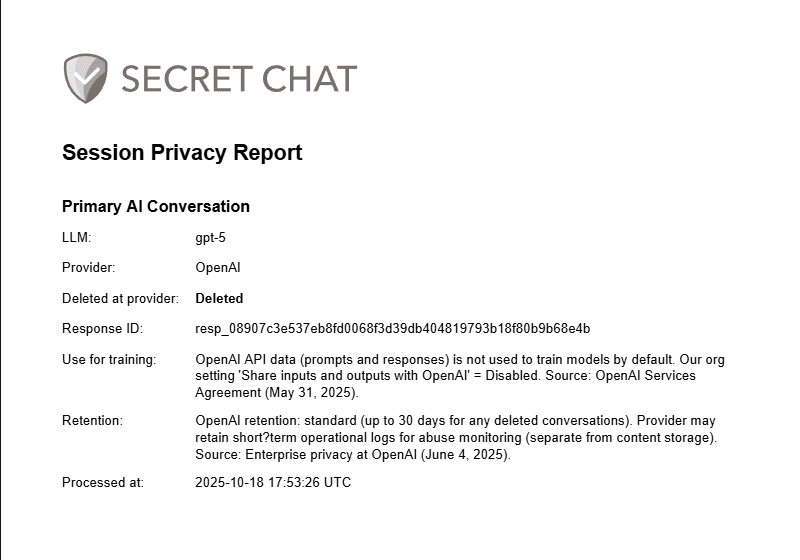
OpenAI's API is governed by different data terms than consumer ChatGPT: API traffic is not used for training, and abuse-monitoring logs are kept up to 30 days. Two qualifications on that number, because a flat "30 days" is tidier than the reality. Material OpenAI is required to keep for legal or security reasons can persist beyond it, and some endpoints create separately retained application state on OpenAI's side, which is a different thing from the abuse log and is what a per-response deletion call actually removes. Secret Chat additionally sends an explicit deletion request to OpenAI for the relevant session, and records the outcome in a per-message Session Privacy Report (PDF) you can keep on file.
Honest scope: what this is and isn't
A private GPT setup like this removes the most common privacy weaknesses of consumer ChatGPT: account-linked cloud history, identity exposure to the model provider, and consumer-tier training defaults. It isn't a fully anonymous network, it doesn't change what the underlying GPT model itself can or cannot do, and it doesn't make any past data on OpenAI's side disappear retroactively beyond their API retention window.
Secret Chat as a private ChatGPT alternative
Secret Chat is a private AI chat app with multi-model access and local browser storage. Used with GPT, it gives you:
- Email-only registration: no name, no phone, no profile-building.
- Local browser storage for chats (IndexedDB) and uploaded files (OPFS). See how local browser storage keeps AI chat history private.
- GPT requests routed through the OpenAI API under business terms, with an explicit deletion request per session.
- A Session Privacy Report PDF for each message that records how the request was handled.
- The option to switch to Claude, Gemini, or Grok within the same interface and even in the same dialogue.
- The AI Council — one question goes to several models from different companies at once, each answer appearing the moment that model finishes, and a referee then builds a disagreement table: which model asserts each claim, which contradicts it, which never mentioned it. ChatGPT's mid tier sits on the panel next to Claude, Gemini and Grok, as a Duet of two models, a Trio of three or the full Quartet, and a Duet on a lighter pair runs free within the daily quota. ChatGPT's own app can re-ask its own tiers; it will never put a rival's answer beside its own.
FAQs about Private GPT
Is there a truly private version of ChatGPT? +
OpenAI doesn't offer a dedicated "private ChatGPT" product to consumers. The closest practical option is to access GPT through a gateway that uses the OpenAI API under business data terms, like Secret Chat.
Can I use ChatGPT without an account? +
ChatGPT can be used logged out, though signing in is what unlocks most of it. Secret Chat requires registration, but with an email only (no name, no phone number, no profile-building), and, unlike a signed-in ChatGPT account, the email is never attached to what you ask.
Is using a private GPT the same as incognito mode? +
No, and the gap is wider than people assume. Incognito stops your browser keeping a local record: history, and the site data it discards when the last private window closes. It changes nothing about the request that leaves your machine: your account, your IP and the prompt itself reach the provider exactly as they would otherwise. A secure ChatGPT alternative like Secret Chat additionally changes how the request reaches OpenAI (via API business terms, decoupled from your identity) and where your conversation history is stored (in your own browser).
How can I be sure my data is actually deleted? +
Look for tools that produce verifiable evidence. Secret Chat's Session Privacy Report records, per message, what retention regime applied and, for OpenAI and Grok, whether the deletion request was acknowledged.
How does Secret Chat compare to other anonymous GPT services? +
Lightweight "anonymous GPT" sites typically offer one model with no account, but no local storage, no multi-model access, and no per-session evidence. Secret Chat adds email-only registration, local browser storage (IndexedDB + OPFS), multi-model access, and a Session Privacy Report. See the main private AI chat page for the full picture.
Can I compare ChatGPT's answer with Claude's? +
Yes. That's what the AI Council is for. You ask once and ChatGPT, Claude, Gemini and Grok answer in parallel, each answer opening as that model finishes; a referee then extracts the factual claims and shows which model asserted each one, which contradicted it and which never mentioned it, followed by a short synthesis of what at least two models agreed on and a list of points to verify before acting. You can run two models, three, or all four, and a Duet on a lighter pair is free within the daily quota. Two things to keep in mind. Agreement is evidence, not proof: models share training data and can be wrong together, so disagreement is the more reliable signal. And a council widens where your question travels, since it reaches every model on the panel plus the referee.